The Freedom Trail
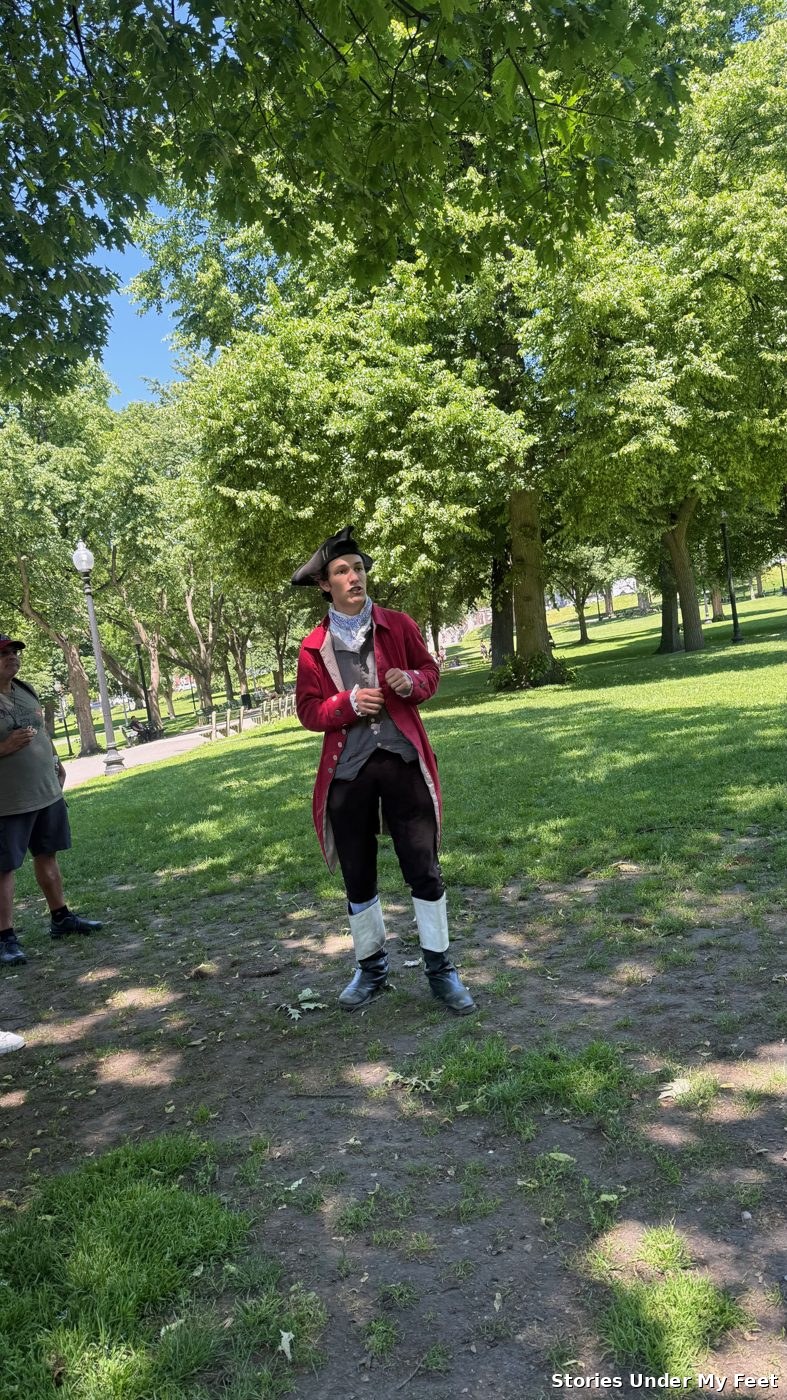
Two and a half miles of red brick winding through downtown Boston, past the places where a colonial city argued itself into a revolution. What surprised me most is how small everything is. History here isn't behind glass — you lean on the same railings the patriots did. Here are the sixteen official stops, with what caught my eye at each.
The stops
1. Boston Common
The oldest public park in the country (1634), once used for grazing cows and hanging pirates. If you want to enjoy it like a local, grab a sandwich and eat it on a bench. My pick: a roast beef from DeLuca's Market on Charles Street, eaten looking out at the Common with the skyline behind it — the whole experience in a nutshell. The Tadpole Playground, marked by a frog-statue arch, is a sweet family corner.
2. Massachusetts State House
Charles Bulfinch's gold-domed capitol on Beacon Hill. That dome was actually covered in copper by Paul Revere's own company back in 1802.
3. Park Street Church
Outside only. "My Country, 'Tis of Thee" was first sung here on July 4, 1831 — and William Lloyd Garrison delivered his first major anti-slavery speech here in 1829.
4. Granary Burying Ground
My favorite stop. Samuel Adams, Paul Revere, John Hancock, and the victims of the Boston Massacre are all here. James Otis's stone has a skull carved into it — a little morbid, a little cool. Full card: Granary Burying Ground.
5. King's Chapel
Outside only. Boston's oldest burying ground (1630) sits beside it; the chapel was the first Anglican church in Puritan Boston — not a welcome one at the time.
6. Old City Hall & the Boston Latin School site
It's a fancy steakhouse now (Ruth's Chris), but this spot is the original site of the Boston Latin School (1635), the oldest public school in America. Benjamin Franklin attended and dropped out right here. Full card: Old City Hall (Ruth's Chris).
7. Old Corner Bookstore
It's a Chipotle now. This one actually hurt — it used to be a hub of American literary publishing.
8. Old South Meeting House
Second visit; the exhibits had changed, and one installation — a woman in a mask, since women couldn't speak here originally — echoed "I can't breathe" in a way that landed. This is literally where the Tea Party got started, an overflow meeting on December 16, 1773. Full card: Old South Meeting House.
9. Old State House
Where the Declaration was first read aloud in Boston, July 18, 1776. The gold lion and silver unicorn on the gable are replicas — the crowd tore down and burned the originals right after that reading. Full card: Old State House.
10. Boston Massacre Site
A ring of cobblestones marks where five men died on March 5, 1770. The story is smaller and stranger than the name suggests — it began with a teenage apprentice and an unpaid wig bill. What moved me: John Adams, a patriot, defended the British soldiers in court because everyone deserved a fair trial. See the Boston Massacre and Crispus Attucks.
11. Faneuil Hall
The "Cradle of Liberty." The gilded grasshopper weathervane dates to 1742, and Samuel Adams' statue stands defiantly out front. Full card: Faneuil Hall.
12. Paul Revere House
$6, worth it. The oldest building in downtown Boston, and home to Paul Revere — silversmith, engraver, and randomly, part-time dentist, with 16 kids across two marriages. Full card: Paul Revere House.
13. Old North Church
Under construction when I visited. Easy to forget this quiet neighborhood is where the "one if by land, two if by sea" lanterns of the Midnight Ride were hung. Full card: Old North Church.
14. Copp's Hill Burying Ground
A high, quiet graveyard in the North End with a view across to Charlestown — where the British aimed their cannon during Bunker Hill.
15. USS Constitution
"Old Ironsides" (1797), the oldest commissioned warship afloat. Beautiful ship, high security to board but worth it. Skip the museum across the street — it felt more like a Navy recruitment pitch than history.
16. Bunker Hill Monument
Isolated from the rest of the trail, but highly recommend. 294 stairs to a view of the whole skyline and the Zakim Bridge. Full card: Bunker Hill Monument.
Bunker Hill, in more depth
The battle (June 17, 1775) was technically a British win — they took the hill after three assaults — but lost over 1,000 men against about 450 American losses, which shattered British confidence that the rebellion would fold quickly. The militia, led by Colonel William Prescott and General Israel Putnam, actually meant to fortify Bunker Hill itself but made a last-minute, still-unexplained decision to dig in on the more exposed Breed's Hill instead. The famous "don't fire until you see the whites of their eyes" line is likely a myth — if anyone said it, it was probably Prescott, telling his under-supplied men to conserve gunpowder.
Roughly 150 Black and Indigenous soldiers fought here in an integrated militia — notably Salem Poor, commended by 14 officers as a "brave and gallant soldier," and Jude Hall, who escaped slavery to fight and served the whole war, only to see his own sons later kidnapped back into slavery. A gutting detail that complicates any tidy "the Revolution meant freedom" story — as does the fact that some Patriots honored on this trip, including John Hancock and James Otis, were themselves slaveholders.
Joseph Warren — the leading Boston organizer, who sent Revere and Dawes on the Midnight Ride — died here fighting as a private, days after being commissioned a general.
Other finds
A facsimile of the original Dunlap Broadside (the first printed Declarations, rushed out the night of July 4, 1776, reading "John Hancock, President" since most signers hadn't signed yet); the story of Evacuation Day; and the Four Flags of Bunker Hill, ending with the Grand Union Flag that first symbolically united all thirteen colonies.
Omni Parker House (just off-trail) — birthplace of both Boston Cream Pie and Parker House rolls (1855–56), and the longest continuously operating hotel in the country. Wanted the pie, couldn't get it. Next time.
The Big Dig (all around you downtown) — much of this walk runs over what used to be a hulking elevated highway. From 1991 to 2007 Boston buried its central artery underground — the most expensive highway project in U.S. history, about $14.6 billion to build and closer to $24 billion once the interest is counted (not the couple of billion I'd assumed). A small trail-sized footnote: State Street, where the Boston Massacre happened, was King Street until the Revolution — the name got a patriotic scrub afterward.
Yankee lobster roll + clam chowder — $39 nearly everywhere. One shack's hand-painted sign summed up the whole genre: "Wicked Fresh, Crazy Good."
My take
If you do one thing in Boston, do this — but slowly. The plaques reward reading, and the burying grounds especially are worth lingering in. The trail turns a textbook list of names into people who lived on specific corners and are buried a short walk from where they argued.